
Sidewalk Talk got its start when founder Traci Ruble had a dream. From that dream, it grew into a way for communities to connect and listen to each other in the most simple of ways. A conversation on the street, on equal ground.
“I’ve told this story so many times, and I feel like the answer is very unsatisfying,” Ruble told Louisville Independent via Zoom. “But it started from a dream. I had a dream that I was going to put my therapist chair on the sidewalk. At the root of it, I’m a therapist. I’ve been a therapist for 21 years, and I think therapy is weird.”
Despite a lengthy career as a therapist, Ruble finds telling a stranger your secrets still a rather odd practice.
“Don’t get me wrong, I believe in therapy. I think it helps. I do lots of training. But I started to wonder, ‘Huh.’ If we save all of our secrets and our vulnerabilities and the things that scare us or excite us or make us proud for this stranger in an office, how does this impact how we relate to one another? How does therapy change our culture?”
In this idea, Ruble found herself staring in a ‘mirror’ in confrontation with herself and the years she’d spent working in the field of mental health.
“I think I was confronting myself. I like to do that. I think I have that kind of confronting myself kind of vibe. I’m always a little curious about why do I do the things that I do. And I’m always questioning it. And then I’m a little bit playful. I’m a little of a trickster-y kind of energy.”
Taking the idea of her therapist chair in the street also gave Ruble a chance to consider how therapists wield a certain amount of power and how being on the street, with just a couple of chairs, changes the dynamic.
“When you sit on the sidewalk as an equal, you have just yourself. And for me, it was such a really powerful juxtaposition, and it changed how I do therapy.”
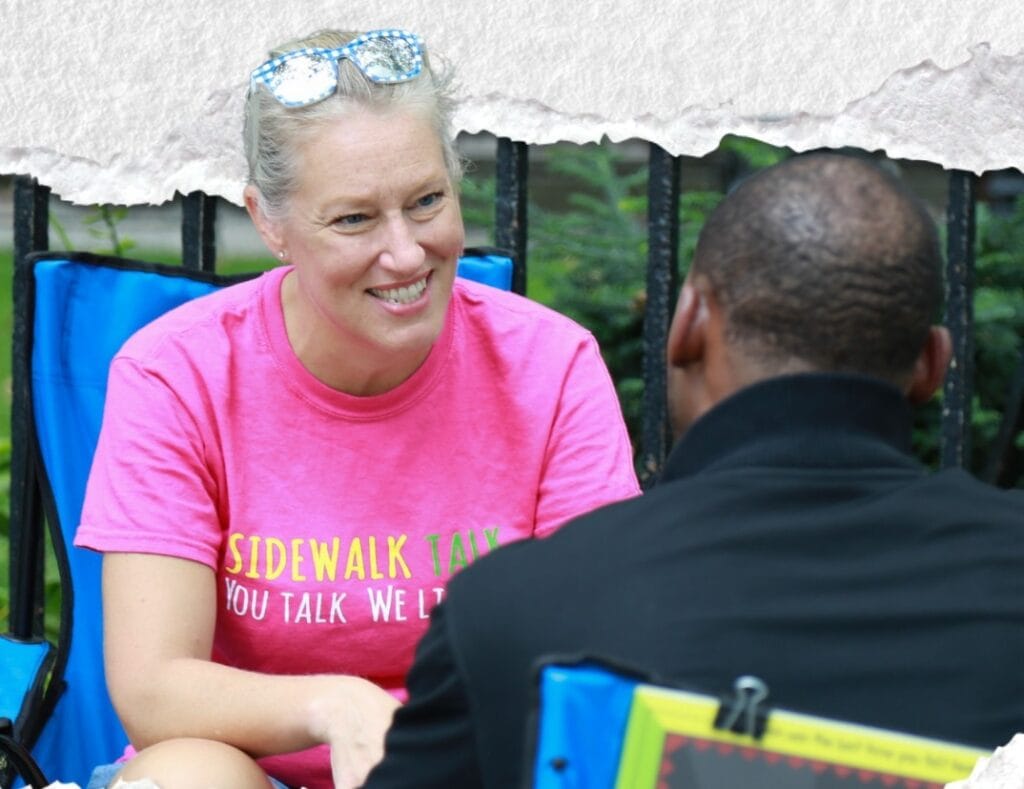
To some degree, the therapist-client relationship depends on there being a problem. People seek therapy to help solve an issue or a behavior. Talking on the sidewalk doesn’t have the same structure or rationale for the interaction.
“I really trust my clients when they come in and they’re struggling, I don’t think they’re sick. And there’s sometimes something about therapy that… I think there are great therapists that don’t do this… but there is something about the model sometimes that kind of frames it as, ‘There’s something wrong here.’ Now I ask, ‘What do you need here? It’s a different frame.
“And that came from listening to people on the sidewalk. ‘What do you need here?’ Not, ‘What’s wrong here?’ It also changed how I ask for consent in the room.”
Confronting therapy as a process to give clients something they need has helped Ruble change the power dynamic to give clients more agency and ownership of their sessions. She believes it helps their trauma heal.
“The first time that I listened on the sidewalk, I realized how sacred it is to connect with another human — what a privilege it is. And I realized that when you’re listening as an equal, not to help someone out, but really, ‘I’m just your equal community member. I’m sitting here on the sidewalk to demonstrate care of community.’ I actually feel a part of that community that’s being cared about. You see, now I’m contributing to something that I’m a part of.”
Ruble is bringing Sidewalk Talk to Louisville on the Sidewalk Talk Listening Bus Tour on Tuesday, May 7, and partnering with Mental Health Lou.
Amanda Villaveces, Licensed Marriage and Family Therapist and Director of Mental Health Lou, connected with Ruble and was excited about the idea of Sidewalk Talk coming to Louisville.

“I thought this is actually exactly the kind of stuff that Mental Health Lou loves,” Villaveces said in a phone interview. “Like, we love this idea of how do we make mental health feel very acceptable, and also how do we make it so that people understand that mental health is not just seeing a therapist. Taking care of your mental health is something that can happen on a day-to-day basis.”
Mental Health Lou works to expand access to mental health services and resources by partnering with local organizations, mental health professionals, and community members. They work with historically underserved individuals and try to address and remedy barriers to care.
“I think this is just a really great example of where something as simple as the way we interact with one another — learning to listen and be present with each other — is incredibly beneficial for one’s mental health.”
In addition to working with Sidewalk Talk for the Bus Tour event, Mental Health Lou is in the midst of their library series.
“It’s Mind, Body, Wellness. Those run through the end of May, and they’re just free workshops for people to come and gain some mental health tools, learn about digital detox, nutrition, and all the pieces of our life that impact our mental health.”
That series can be found on the Louisville Free Public Library Site here: lfpl.org/mindbody
Join the Sidewalk Talk Listening Bus Tour in Louisville on Wednesday, May 7, from 4 – 7 p.m. in front of Story Louisville (828 E. Market St.). More info about the bus tour here: sidewalk-talk.org/2025-listening-bus-tour.
Before the date, Sidewalk Talk would like to know more about the city of Louisville through the eyes of residents. Take the survey before the event: bit.ly/StoryOfYourCity.