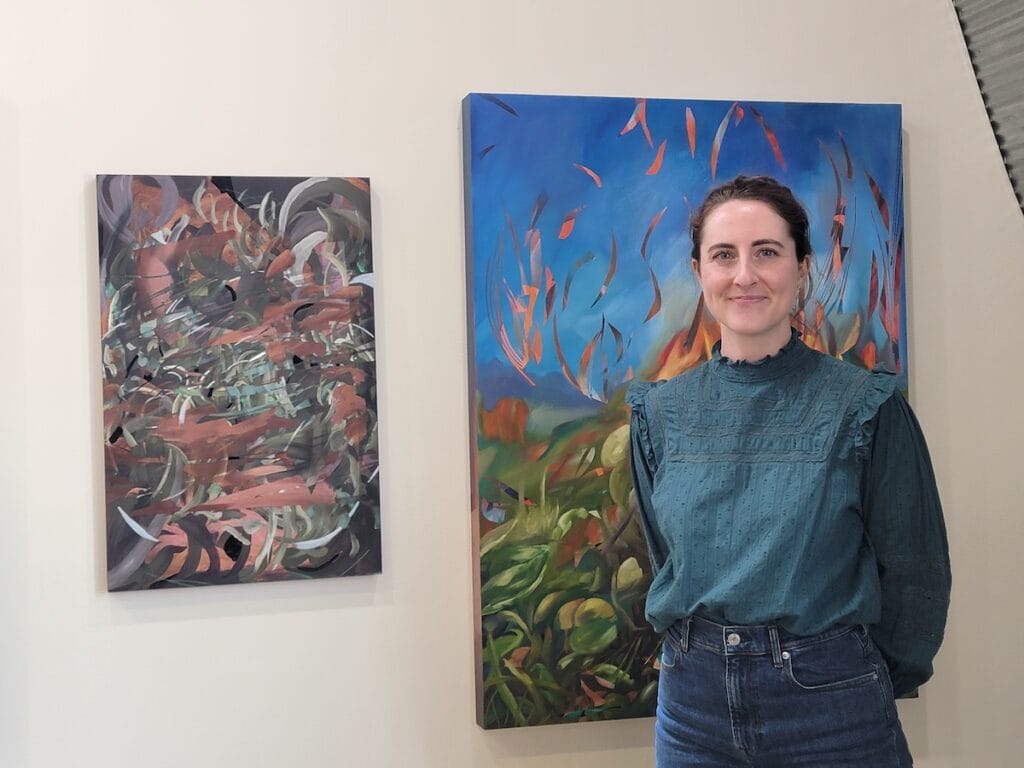
Art conversations are rarely linear. Artists are dreamers and thinkers, and spend a lot of time in the atmosphere of meanings. It makes sense that a conversation between me, artist and gardener Sara Olshansky, and gallerist Leslie Millar would twist and turn into magical, and sometimes dark spaces.
In April, shortly after the opening of Olshansky’s “From Beneath and Far Below” show at Millar’s Quonset Hut Gallery, we sat down for lunch and conversation about the show, about the world, and so many things. Read this as just that, a conversation. It’s a consideration of an artist and where she finds her space in the art world.
Conversation has been edited for space and clarity
Leslie Millar: I have two specific things that I wanted to mention about working with Sara. Number one, Sara is so loved. Look, I’ll get all choked up. We had the opening on Saturday night. It was cold, it was pouring rain, and I had even talked to the jazz band, ‘Maybe you might want to come back and play another time, because I don’t think people are going to show up because it’s so miserable outside.’
We probably had, like, 75 people here. It was a great party. I didn’t really try to keep count. I never really pay attention. So many people told me their stories of how they are connected to Sara and their relationship with Sara, and it was incredibly touching.
So Sara, beyond being a great painter, is a great person.
At the party, Millar discovered that Olshansky is not only a great painter but mixes and makes her own paints, and wanted to know more.
Sara Olshansky: This body of work in particular, I made all the panels or I commissioned somebody to make them, and all the paints, if they’re oil, I don’t make the oils, but I source my acrylics from a company in New York called Guerra Paint and Pigment. They typically do mural paints. But, I was trying to find a formulation that would be really matte, really opaque, and be sanded very smooth. I found an acrylic that they use a silica additive so that it’s very mattified, and it actually dries really quickly, so I can use this material in several layers in one session.
Louisville Independent: So you can work quickly?
O: Exactly, Which is important because I want these to be heavily layered. And, the part of the concept is that with the addition, there’s also subtraction. The addition of paint on top might add detail, but it also represents, like, a loss of what’s behind it. And then certain, like, sections are preserved with a veneer or a mask, you know, like a masking tape or something, which when they have, like, 20 layers or something like that, you can see the very beginning next to the latest. It’s like this collapse of time, because I’m trying to make these landscapes appear as if they’re in motion and shifting, and shifting quickly.
M: I’ve never met somebody who made their own paint just because there’s so much paint that’s readily available. So what was the moment where you had that realization? These do reward multiple viewings. And James and I, I mean, we put this show up. It’s been up for, what, three weeks now before the opening? So we’ve had a lot of time to sit with them, and there are constant revelations.
O: There was a body of work that I did for Berea College, where I was doing, like, these cutout panels. I took a panel that was in front, but made it a solid color.
And I wanted it perfectly smooth. I needed a material that could stand up to lots of sanding and lots of layers to create a very perfect, smooth surface. It took me some time, and I wanted it to be really matte.
Some of the finishes are being sort of.. It’s like a play with different refractions. There’s a mirrored vinyl in one of these with an ultra-matte black.
And, I was like, well, what could these do? Could these create the illusion as if they have those compartments that are cut out? But, they’re not. They’re fake or pretending to be that way. So, some experimentation is in this final body of work that you can see. It really was about achieving a certain effect, and what materials, after trial and error… what was really doing that.
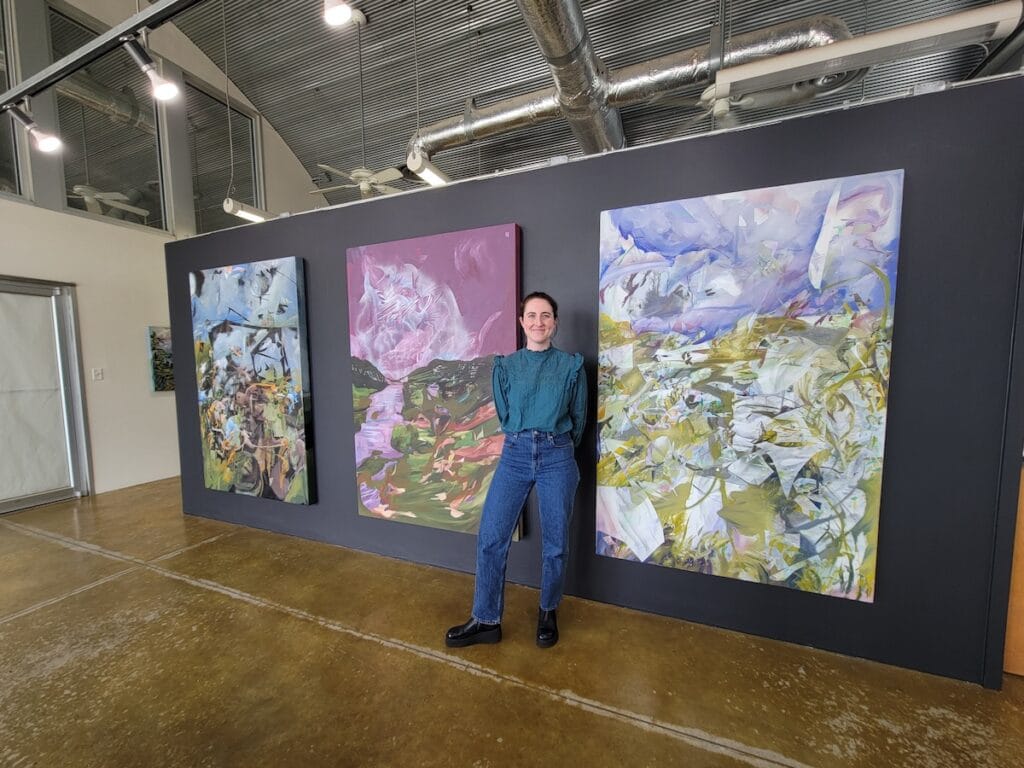
Something I think a lot about is, these are paintings which claim to demonstrate the changes in the landscape because of the climate crisis, but at the same time, that sort of addition and subtraction in the layers. It’s similar. It tracks with these. The addition of these into the world. Their creation is simultaneously an extraction of the natural resources it takes to make them. In some ways, they’re kind of hypocrites. It’s something that holds my interest quite a bit. It’s something I’ve been trying to deter. I’ve been trying to interrogate what it means to be a painter today, and what it means to be a landscape painter, an American landscape painter during the climate crisis.
The idea with these layers is that it would hopefully reveal itself slowly. I want to call it mastering of the visual field. It’s like this thing in art that’s like, ‘can you understand it?’ And I hate that term.
M: The other day, my oldest kid volunteers in a Holocaust museum in Albuquerque, and after going there, I asked [them], ‘What is the master plan?’ And it just. That word just stuck in my mouth, and it’s getting rid of the idea of mastery and master. The word master. There are people who are diligently working on getting rid of this type of terminology, but that’s what you’re reflecting, right? Especially in a Holocaust museum. How can you say, what’s the master plan? This was the master plan that they were trying to execute.
What’s the verbiage, or the terminology? I guess it’s also just completely absconding or admitting defeat. There is no conquering or of the landscape, or of painting, or whatever medium that you choose to reflect. It is impossible. It’s all a guess.
O: I’m an American landscape painter who’s aware of that history. I’m trying to apply these techniques that take an image that could be similar to those Hudson River School paintings, but breaking it apart, and there’s no mastery of these.. They create sort of like a counter narrative narrative to that, especially in the context of the climate crisis.
It is at this point that our conversation veers off course into a discussion of the rise and fall of empires. We considered what empires of the past experienced during the World Wars and spoke about the lessons America had the chance to learn from 9/11 about its interactions with the world.
O: It’s like the Hudson River School — that was in the service of an empire… of imperial pursuits. Futurism became very fascist. They started as anarchists and then were just absorbed into the fascist movement. I think when you talk about painting, you have to also talk about the ways that painting has been used in service of these things, and that’s kind of what I’m trying to get at when I say, ‘why am I a painter today?’ Considering, it was popularly thought that abstract modernism was the death of painting and the end of conceptual growth in painting. Part of why painting is still here is its proximity to the market and its proximity to commodity. All of these things are in play.
They have to go somewhere. It’s this weird, weird balance. If I’m worried that these are extractions and wasteful, I can’t just keep making them and hoarding them in the studio. They have to go somewhere. So then do they have to be purchased? Do they have to be purchasable? And then is that still along the same legacy?
M: What would be the ideal place for your work to be placed? Where would you like to see these paintings?
O: Sometimes this impulse to make them is so intense that I just do it, and I don’t consider where they are going. And, what are the effects of them? But I was talking to someone in the studio who said something like, ‘Oh, these are so pretty,’ and they meant it in a good way.
LI: Sometimes that is not what you want to hear.
O: Sometimes in painting, you’re almost taught to not want them to be.
LI: Right, pretty means you think someone at K-Mart or Target, or whatever. Decorative.
M: So, it means it’s not serious.
O: You’re taught to sort of resist that. As much as I emphasize this sort of criticism, I want people to enjoy these, and I want them to be a part of people’s lives in their homes or wherever.
Olshansky’s “From Beneath And Far Below” will be at Quonset Hut (599 Rubel Ave.) through June 1.