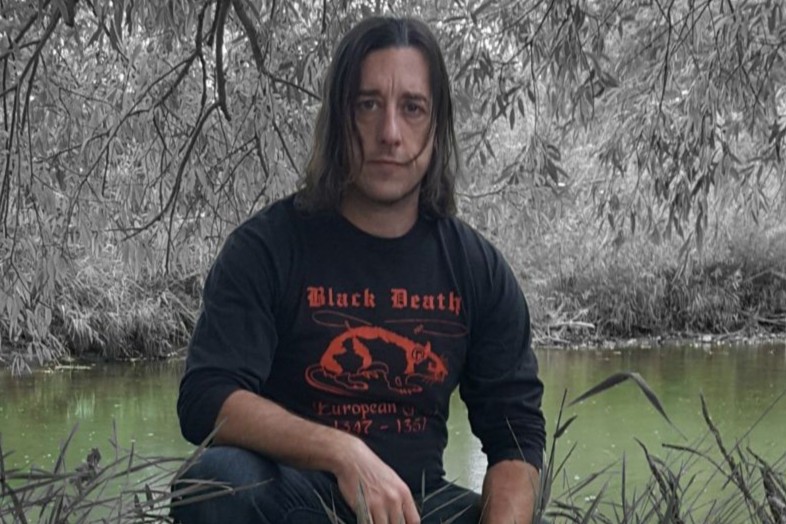
Brian Moody seemingly came out of nowhere in 2026. The debut album, Brian’s Brain — his fully-realized one-man solo project — had been out for some time. Still, seemingly overnight earlier this year, it began receiving play here on LRS102, as well as on radio, podcasts, and mentions/reviews in media worldwide. Which led LIO to wonder, just who is this guy?
Brian Moody is a one-man melodic heavy metal force who composes, performs, and records all of his music himself, personally taking on all guitar, bass, keyboards/piano, drum programming, and vocal duties. And the music: dark, apocalyptic, atmospheric, and overall powerful, with each song creating an intense soundscape that immerses the listener. But at the same time, his songs are catchy as hell, full of hooks, and with each track on Brian’s Brain clocking in at around four-and-a-half minutes in length on average, they are approachable. And with an impressive vocal range that goes from Ozzy-esque harmonies to Joe Duplantier-style growls, comparisons to newer Ozzy Osbourne material, Gojira, Devin Townsend, Amorphis, In Flames, VOLA, and Katatonia are certainly warranted. In short, this is top-notch metal that you really need to hear!
You can check out Brian Moody’s work at: push.fm/fl/brians-brain-brian-moody and brianmoody.bandcamp.com
Louisville Independent Observer: What is your background as a musician?
Brian Moody: My journey as a musician has been a long-form evolution from technical foundations to creative obsession. It started in the 5th grade with piano lessons in my hometown of Louisville, KY, which gave me an early ear for melody and atmosphere before my family moved to La Grange when I was in middle school. By the late 90s, I hit my ‘sonic pivot,’ trading grunge for the intensity of Pantera, Slayer, and Sepultura.
One of my earliest milestones was playing bass in a band for the 1999 ‘Follies’ talent show at OCHS—we performed in full leather ‘metal’ outfits and corpse-paint, like in the early ’90s European black metal scene, earning an ovation that proved the power of theatrical metal. After high school, life took me into the ‘dark years’ of manual labor and academics as I wasn’t picking up the guitar as much during this time, instead pouring concrete for Abel Construction while attending UofL in the evenings. I was a laborer and student by day, but an apprentice of the ‘Wall of Sound’ by night, eventually switching to Open C tuning after discovering the work of Devin Townsend, that inspired me to begin picking up the guitar once again.
That blue-collar work ethic followed me to Colorado in 2019. When the pandemic hit in 2020, I transformed the isolation of the mountains into a self-taught masterclass in audio engineering. I locked myself in my basement, mastered Reaper DAW, and built the foundations of what would eventually become the Brian’s Brain album. I’m not just a musician; I’m an architect who had to work through the trenches to finally build my own laboratory.
Musically, what are your biggest influences?
My musical DNA is a bridge between 90s metal atmosphere and modern technical weight. If I had to narrow it down to a ‘Mount Rushmore,’ it would be Devin Townsend, Gojira, Type O Negative, and Mastodon. Devin Townsend was a massive turning point for me; his Physicist album in 2000, along with his Infinity album in 1998, were so impactful that I permanently swapped my guitar to open C tuning to attempt to learn how to play his songs, and to chase that resonant ‘Wall of Sound’ he is famous for. From Type O Negative, I inherited a love for slow, somber, heavy gothic melodies. Then you have the technical, earthy stomp of Gojira and Mastodon, which provided the blueprint for the aggressive architecture of my riffs. It’s a blend of high-concept theater and blue-collar grit. One of my underlying goals was to craft riffs that were easy to headbang to in combination with taking the listener on a sonic journey.
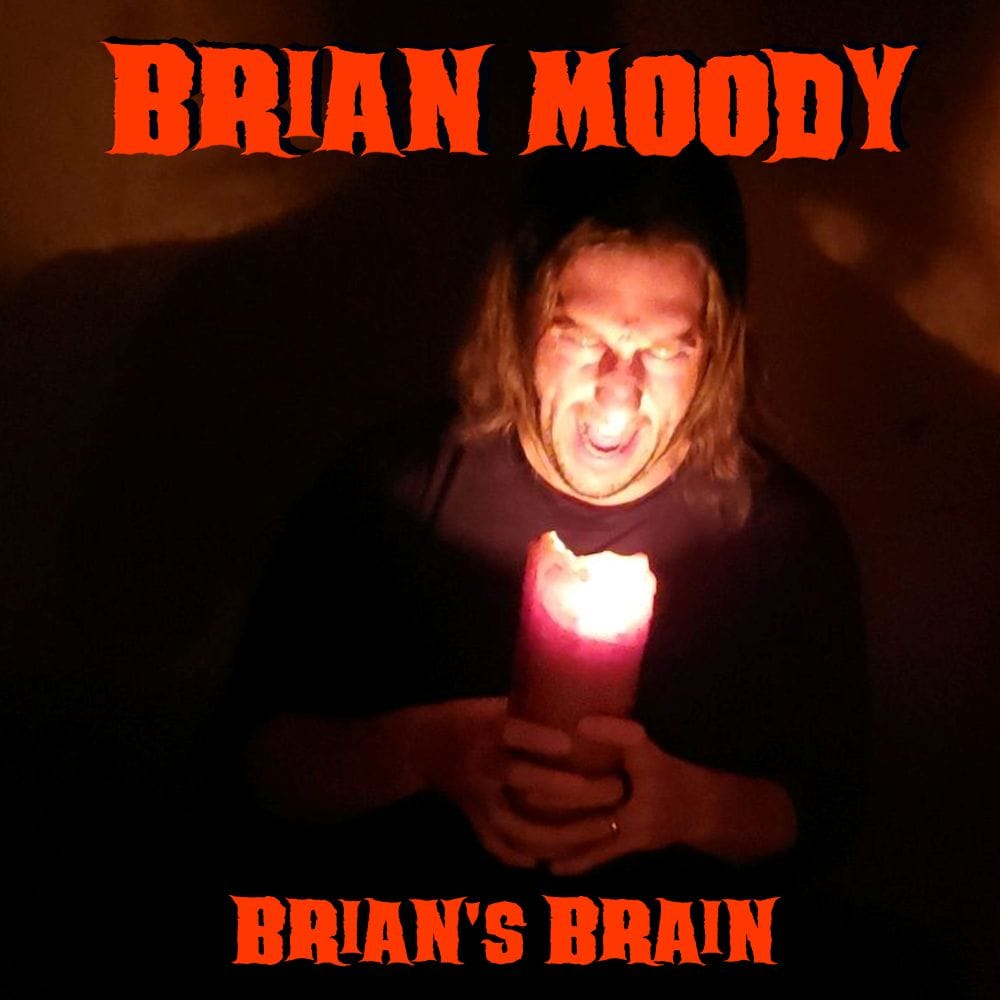
You played all instruments and did all vocals on your debut album, Brian’s Brain, yourself. Although you are obviously proficient in all instruments on the album, a lot of bands/producers bring in studio musicians to record. Is there a reason why you chose to tackle all elements of recording this album by yourself?
The ‘one-man band’ approach wasn’t a choice of ego—it was an executive decision to protect the creative vision. After years of playing in bands that fizzled out or felt like a compromise, I realized I was a producer at heart. I wanted ‘Brian clones’ who could see exactly what I saw. Once I started layering tracks in REAPER DAW, I found I could finally ‘play music with myself’ and demand the exact soundscape I envisioned. My years of physical labor pouring concrete and my time in computer technical support jobs forged the mental stamina to obsess over every note. I’m the architect, the laborer, and the inspector. I’m willing to miss meals and lose my voice in the studio with endless track takes because I trust myself to see the vision through to the end with intense tunnel vision. I strive to get as close as humanly possible to perfecting my art form. I become obsessed, or possessed, until I am content with the final product.
This album took 2 ½ years to record, correct? What can you tell me about the recording process?
This was a steep learning curve into what became an ever-evolving ‘laboratory’ work. It began in the isolation of the Colorado mountains during the 2020 pandemic. I had to teach myself the engineering side from the ground up—learning REAPER, mastering EZdrummer 3 programming, and refining my vocal chain.
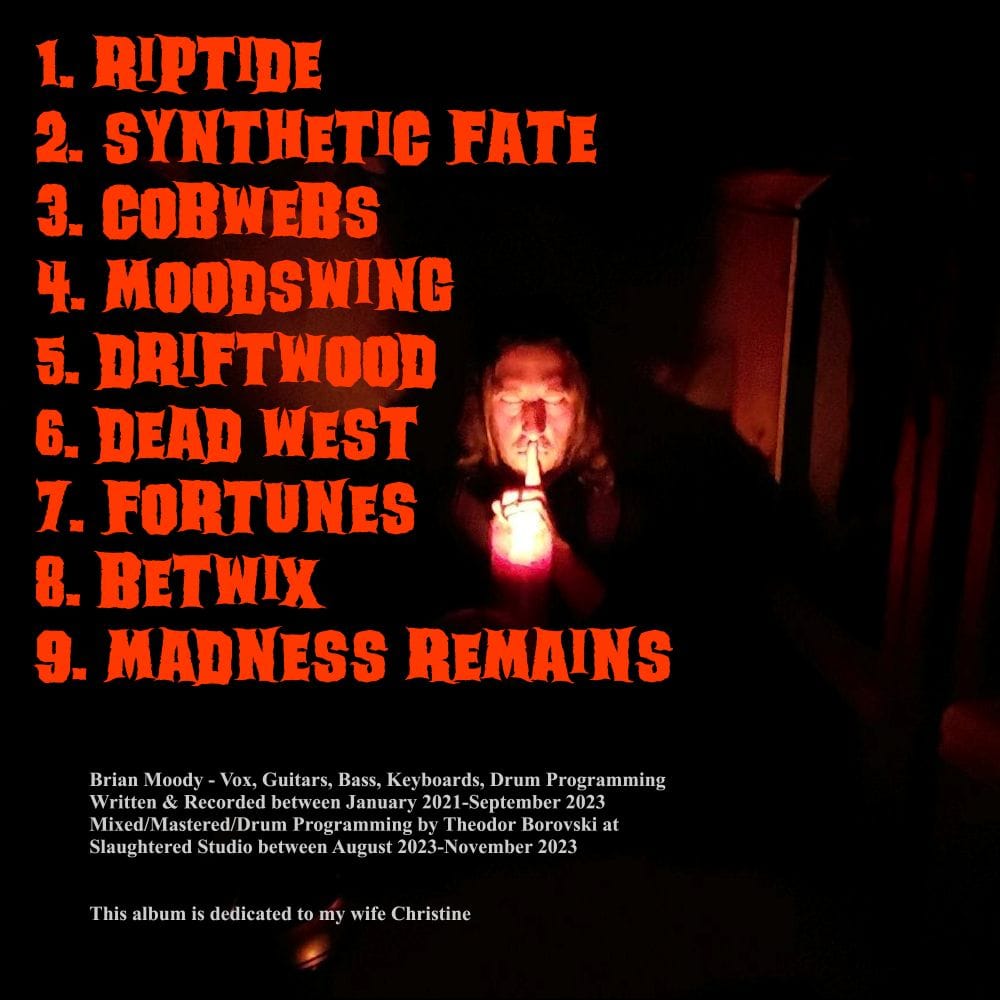
The project originally existed as a 7-track demo album called Into the Fyrium, named as a tribute to a close friend I lost to cancer in 2019. The ‘Fyrium’ name came from his video game handle on the internet. Over the next two-plus years, I meticulously polished those demos further while also writing new material. Brian’s Brain is the result of 30 months of isolation, technical obsession, and the desire to imprint my entire life’s journey into 9 audible tracks. It wasn’t ‘recorded’; it was designed and built.
I know you recorded your album, Brian’s Brain, here locally, so how did Theodor Borovski at Slaughtered Studio in Moscow, Russia, get involved with your project?
I knew the songs were strong and I stood by them, but I wanted a world-class ‘finisher.’ I researched engineers globally on SoundBetter and found Theodor Borovski with Slaughtered Studio. After I learned of his credentials and experience in audio engineering, along with his time as a drummer for a band named Second to Sun, I knew his ear for metal was exactly what my sound needed.
We collaborated remotely from August to November 2023. I’d send him my raw REAPER sessions, and he would mix, master, and ‘humanize’ the drum programming in Moscow to take it all to the next level. I’d give my feedback on the mix, and he would tweak it with my suggestions, and then rinse and repeat until I was satisfied. Despite the thousands of miles between us, we worked in perfect harmony. It’s a testament to the modern age: you can build a bridge from Kentucky to Russia to create something that sounds like it was recorded in a major-label studio.
Your album was released over two years ago, but has recently picked up a lot of steam as far as radio play and press. What do you attribute this to?
It was a calculated pivot from ‘Musician’ to ‘CEO.’ After the album was finished in 2023, it sat dormant because I didn’t have the map to market it. I was a loner in a basement. This year, I decided to force my way into the minds of the people who matter.
I launched a strategic Groover campaign that landed me on 16 countries’ radars, Glacer FM web radio, and on the Metal Madness Weekly Apple podcast. That momentum next hit LRS 102, and after that, Metal Devastation PR added fuel to the fire, recently securing my music on a 90-day rotation in Italy with Antennaweb Radio, and the explosion has been intense. I’ve reached 37,000+ fans in South America and the 502 in just a few weeks. I stood up Brian Moody Music LLC to manage this growth. I’m no longer waiting for permission; I’m building a legacy for my family.
Have you begun writing/recording a follow-up album yet?
Absolutely. I’m already back in the ‘laboratory’ here in Kentucky, engineering the next chapter. My creative stride feels stronger than ever, and I’ve begun tracking demos for a follow-up EP targeted for October 2026. October is my birth month, and I’ve always been drawn to the atmospheric shift of Autumn—the horror movies, the gothic themes, and that heavy, somber energy. This release is particularly meaningful because it will be the first Halloween I share with my son, who is due in late March 2026, so just around the corner. To take the production to the next level, I’m planning a deeper collaboration with Theodor Borovski at Slaughtered Studio. While Brian’s Brain featured programmed drum elements, we are aiming for Full Live Drum Tracking for this EP to add even more ‘human soul’ and weight to the tracks. I’m moving from 9 tracks of isolation to a new 3-to-5 track surgical strike of pure atmospheric metal.
Any plans to put together a full band to play your songs live?
At this time, my focus is entirely on being a Studio-Based Content Creator. I’ve found that the ‘Mad Scientist’ environment of the laboratory is where I hit my highest creative stride. Creating a sonic monster in REAPER—layering every atmosphere and cinematic texture myself—is a thrill ride that I’m currently obsessed with. By remaining a solo studio project, I have the absolute creative breathing room to tinker and refine without negotiation or compromise. It’s an incredibly efficient process for me: make music, promote the brand, generate revenue, and repeat the cycle.
Most importantly, this model allows me to prioritize my family. With my son arriving this month, being in the studio means I’m present for my wife and child while still engineering global ‘sonic journeys.’ I’m no longer in the mental trenches I once inhabited; I’ve traded the stage for the laboratory, and I’ve never been more committed to the layers and the atmosphere.
What are your proudest accomplishments so far as a musician?
Beyond the music itself, my proudest accomplishment has been the discipline to see a total creative vision through from the first riff to the final master. There is no higher satisfaction than layering drums, guitars, bass, and keyboards in REAPER and watching a ‘sonic monster’ take on a life of its own. It is a creative ‘high’ that nothing else in life has ever competed with.
On a professional level, landing a spot on my hometown station, LRS 102, was a massive milestone. I grew up listening to them, so hearing “Madness Remains” on those airwaves was surreal and deeply rewarding. It proved that the ‘Mad Scientist’ in Louisville is a verified local asset.
To then see that same work travel to the other side of the world for a 90-day rotation in Italy is almost unbelievable. Knowing that my art is being shared in foreign lands I’ve never even set foot in is a feeling words can’t quite describe. Finally, finding a world-class collaborator like Theodor Borovski at Slaughtered Studio was a blessing; we worked efficiently together to take this project to a professional global standard.
You mention in your EPK that you’re originally from Louisville, moved to Colorado, and then back to Louisville. What brought about the move, and what brought you back?
The move to Colorado in 2019 was a ‘quest for isolation’ even before the pandemic hit, which itself just exacerbated the situation. My wife Christine and I fell in love with the mountains during our honeymoon at the Stanley Hotel in 2015—a trip that actually sparked my interest in mountain hiking, along with what I believe to be my first legit paranormal experience. We stayed in room 401 at the Stanley, known as the Lord Dunraven Suite, and I was awakened one evening with the sensation that something or someone was sitting on the edge of our bed. I didn’t see anything with my eyes, but I 100% felt a presence in the room with me that gives me goosebumps to this day when I recall the experience. Fortunately, the sensation faded away, and somehow, eventually, I went back to sleep. I’ve always had a fascination with the paranormal in parallel with my love for horror films in conjunction with my heavy metal roots.
We spent the next five years hiking the mountains and uprooting our lives to find that creative breathing room I was searching for. When the 2020 pandemic hit, being ‘trapped’ in a strange land far away from home forced me to finally master REAPER and turn my solitary focus into the foundations of Brian’s Brain.
We returned to Kentucky in 2025 because we felt the quest was complete, and I missed my roots. More importantly, we decided to expand our family. My first child is due this March, and we wanted him to grow up surrounded by grandparents and relatives here in the 502. There is a strange, powerful symmetry to the fact that my album is taking its first global steps in media at the exact same time my son is preparing to enter the world. I moved away to find the ‘Mad Scientist,’ but I moved back to build the Legacy.
Note: You can see our Colorado mountain hiking documentation on the YouTube channel titled ‘Moody Peaks’. There is also the video for the OCHS talent show ‘Follies’ from 1999 on that channel as well. I’ve provided the links:
Moody Peaks: Mount Ikoko
OCHS Follies 1999:
Gear rundown – what are you working with?
I’m a firm believer that the vision is more important than the price tag. I built the foundations of this album in REAPER, teaching myself the DAW from the ground up to ensure I had total control over the architecture. My primary weapon is a black ESP MH-350FR guitar, which handles the heavy lifting of those Open C riffs. For the acoustic layers, I used a black Walden acoustic guitar I picked up right here in Louisville.
Interestingly, some of the most critical ‘soul’ elements of the album come from gear I’ve owned since high school. I’m still tracking with my Peavey International Series Milestone II bass and my Optimus MD-1200 keyboard. They aren’t ‘high-tech,’ but they have decades of my own history in them, and they put in the work.
Everything hits the computer through a Focusrite Scarlett 2i4, and for the drum foundations, I utilized EZdrummer 3. It’s a lean, efficient setup that allows me to move at the speed of my own ideas. For the final ‘Slaughtered Studio’ polish, Theodor and I worked together to take these raw captures and turn them into the monsters you hear on the record.
Any future plans or additional info that you want the people to know about?
Right now, I am operating at the intersection of two massive life cycles. I’ve officially stood up my first global storefront on Bandcamp with the BMM-001 ‘Archive Bundle’, featuring the limited-edition ‘Ghoulish’ shirt and physical jewel-case CDs, along with a copy of the digital master. It’s the first time I’ve ever been able to share a fully realized physical piece of my soul with the world, and the response from 16 different countries has been overwhelming.
But more importantly, I’m preparing for the birth of my son due on March 25th. Seeing these two forces come together at the exact same time—the birth of my musical legacy and the birth of my child—is a level of excitement I can’t put into words. I’m no longer the ‘loner in the basement’; I’m a father and a CEO building a legacy that will be around long after I’m gone. I look forward to returning to my ‘laboratory’ to finish the follow-up EP for an October 2026 release. Life has a mysterious way of working itself out when you commit to the work. To the 502 and my fans abroad: The madness is only beginning, and ‘The Archive’ is officially open.