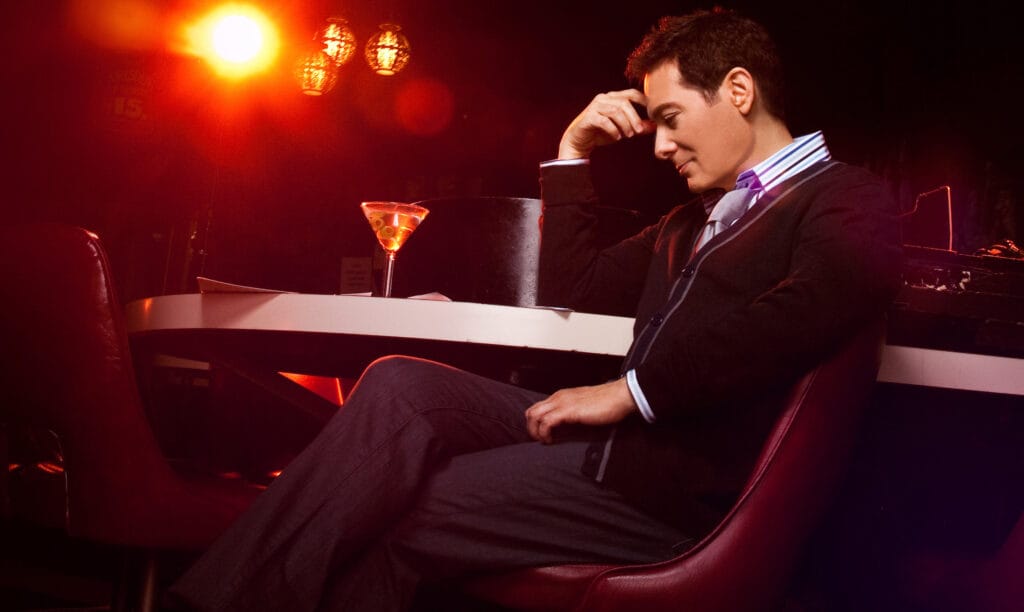
On Friday, April 11, Singer Michael Feinstein pays tribute to the legacy of Tony Bennett with a night of iconic music accompanied by the Louisville Orchestra. In the “Because of You: My Tribute to Tony Bennett,” hear some of the songs that Bennett made famous, including “Because of You,” “Rags to Riches,” “I Left My Heart in San Francisco,” “The Best is Yet To Come,” “I Get a Kick Out of You,” and “Stranger in Paradise.”
Feinstein began playing music as a child, and through years of performing, has honed his art playing some of the world’s greatest stages. Through his work, he’s met and made friends with some of the greatest performers of our time, including a close friendship with Rosemary Clooney, Liza Minnelli, and, of course, Tony Bennett. Throughout the show, Feinstein will share stories about who Bennett was and how his music spoke to the man the public knew and the one that perhaps only those close to him knew.
Louisville Independent had the privilege to interview Feinstein ahead of Friday’s performance.
Louisville Independent: You’ve had quite a career from Ohio to the most famous stages. How did you become interested in performing, and when did you make your first move towards the stages in L.A. and NYC? Broadway?
Michael Feinstein: I started playing the piano when I was 5 years old, and I sat down and immediately was able to play with both hands, so it’s like I always knew how to play the piano. It seems a little odd, but it’s true. It’s just something I came into this life able to do. I started performing professionally when I was in my teens because somebody offered me $25 to play for their wedding, and I was amazed I was actually paid money to play the piano. In my later teen years, I started playing events, different weddings, bar mitzvahs, and whatever anybody needed me for as well as working in restaurants and playing in a couple of piano bars in my hometown of Columbus; and then, when I was 20, I moved to Los Angeles.
It was there that I met Ira Gershwin, the lyricist brother of the composer George Gershwin, and ended up working with him for six years from 1977 to 1983. It was during that period that I started playing in night clubs in Los Angeles and met Liza Minnelli, who was Ira Gershwin’s goddaughter, and Liza hosted a party for me in 1985 that helped to put me on the map and from there I got an offer to play in New York at the Algonquin Hotel and that got me my first major national publicity and from that point on I was booked to play in clubs all over the country and I played the Hollywood Bowl the following year and started touring playing concert halls. So, it was all a gradual evolution, and it just sort of happened. I never had any grand plan or design, especially because I was singing older songs, and I didn’t know how much of a market there was for singing classic songs. There were times when I was fired from jobs because I didn’t play contemporary music. But then that all started to change when I stuck to my guns or stayed in my lane.
You get to pay homage to the great Tony Bennett in your upcoming performance with the Louisville Orchestra. What has Bennett’s voice meant to you (and to the world of the American Standard)?
I think the common bond or common factor of all great performers is that they have a unique sound in the way they perform a song. Tony’s voice is immediately recognizable, and he was unique in so many ways. His voice was not always a pretty voice in that it had a roughness to it that people absolutely loved, and Tony used his particular sound to great advantage. He also had a remarkable range, vocally speaking, and to his dying day could sing high notes that are/were the envy of any singer. He also had different styles, vocally. He could sing operatically, he could sing in a pop style, jazz style, Broadway-style, and he candidly knew when to use those different voices for the particular song he chose to sing. Tony was always looking for new songs that would suit his style. He preferred the classic American popular song to more contemporary pop songs because he felt that often the lyrics or the music weren’t as resonant and rich for his soul.
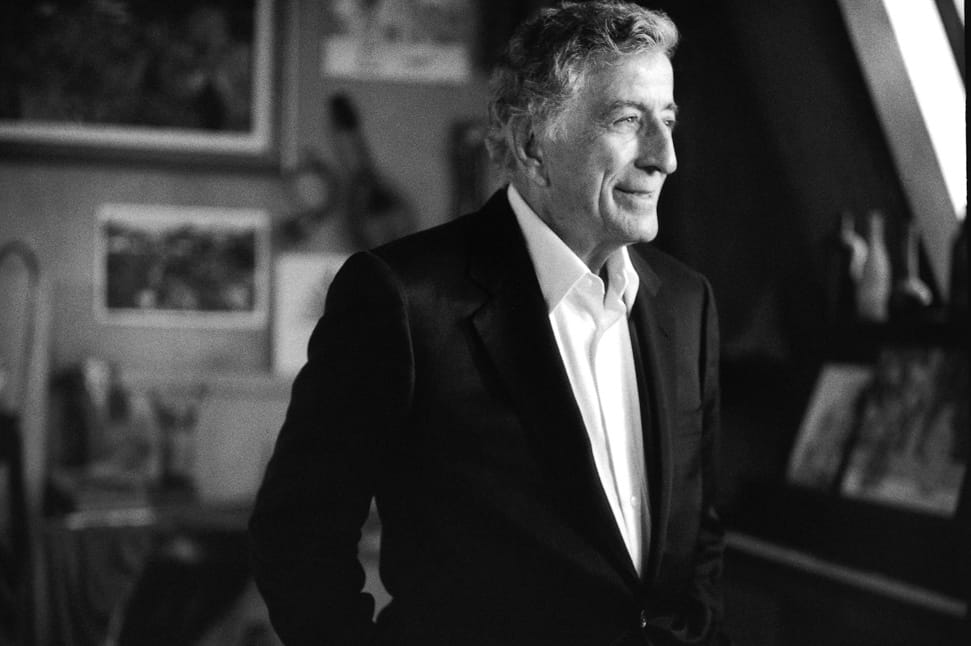
You knew Bennett. How do you think that colors your tribute to him?
Spending time with Tony was always a lot of fun because he had very strong opinions about many things, and he had very strong sense of self and was very confident in what he did musicall,y but most importantly, the music that he chose was music that he felt would uplift or transform his listeners. He was drafted into the army at the age of 18 in 1944 and said he witnessed horrors that made him a lifelong pacifist.
He saw the liberation of a concentration camp in Germany, and that was heart-wrenching to experience the worst of humanity, and at that point, he resolved to use music always as a means of bringing people together and creating as much harmony, peace, and unity as he possibly could in the world. I think a lot about Tony and the time we spent together when I’m singing these songs, and I try to present anecdotes and stories and humorous recollections in a context that will not only illuminate the music that I am about to sing but also help to paint a picture of who he was as a man.
Have you performed with the Louisville Orchestra before?
I have performed with the Louisville orchestra before. I believe that my first time was in the early 90s. The orchestra was known to me when I was growing up because they made so many recordings of contemporary American classical music that I had never heard before. And indeed, the Louisville orchestra became famous for that very thing, so I was quite excited the first time I had the opportunity to collaborate, and I’m still excited because I consider them one of the great orchestras of our country.
What should local audiences expect from the performance?
My show will be a kaleidoscope of songs that are associated with Tony, and they are all curated with stories and anecdotes to put the songs in a context that will either give a greater illumination about Tony’s personal life or about what was happening in the context of our country through the eyes of this music. The music is so amazingly energetic, and to perform it with a symphony is particularly exciting because this music is timeless, and that’s why Tony was popular with multiple generations, because the songs he sang never grew old. They always had appeal to contemporary audiences, and so I try to bring that energy through my own performances.
If you could sum up your career by looking at the value of art in today’s America, what would you say? Do you think that we value music in the same way, or has that changed in your eyes?
It’s certainly fascinating to see what has happened to our cultural life in America, it’s actually tragic. There was standard music and art education in schools when I was growing up, and that affected me very deeply, and that is all gone now. I believe that the deprivation of funding for the arts has created the great divide we experience in our country today. Arts are always the unifying factor that connects people in their hearts, minds, and souls. It’s a place where we can put aside all of our differences and find the common ground of humanity.
That is the tremendous importance of art, and when in this country we started to put the emphasis on education in computer sciences, the internet, and contemporary technology to the detriment of arts education, we lost a part of our soul here. During the Obama administration, Quincy Jones begged President Obama to create an ambassador of the arts, and Quincy hoped he would be named that ambassador because he felt very strongly that to repatriate the arts as an essential part of our fundamental education would create so many positive things in our country. The level of intelligence rises when children are exposed to art at an early age, and boundaries are erased. All of these imposed differences that we are experiencing now vanish when we see through art that every single person on this planet, in their soul, is the same. That is the glory of art.
You had a great friendship with Rosemary Clooney, who is from Kentucky. What can you share about that friendship, and did she ever bring you to Kentucky?
Rosemary was my second mother. She used to call herself my Beverly Hills mom and referred to me as her sixth child because she had five kids. We were very close, she lived next door to Ira Gershwin and that’s how I met her during the period I worked for Ira and I did a couple of hundred of shows singing with Rosemary and she was very proud of her Kentucky roots and I think that is demonstrated by the fact that she had a house in Augusta and I went and visited that house on a few occasions and I also was with Rosemary performing in Maysville her hometown when the Russell Theatre was restored and that was quite a thrill because I met many of Rosemary’s friends and people she had grown up with. Particularly her best friend, Blanchie Mae, whom I had heard of for years, and was so excited to meet.
The most poignant experience I had with Rosemary in connection with her beloved Kentucky was when I went back for her funeral. The funeral was held in her hometown in Maysville and then there was the procession to the cemetery which as I recall was probably about 20 to 30 minutes away from the church and as we traveled in the car for that seemingly endless journey, I was struck by the presence of thousands of people lining the route on the roads to the cemetery. Seeing all the people whose lives she touched with their hats off and their heads bowed in reverence to this woman who meant so much to them. I was sobbing on the way to the cemetery, seeing how much she meant to so many, and I thought that was the most beautiful tribute that could’ve ever been accorded to her. She was truly the voice for the people of Kentucky and the people of America, and I miss her every day of my life.
“Because of You: My Tribute to Tony Bennett” starts at 7:30 p.m. at Whitney Hall (501 W. Main St.) For more information and tickets, visit: https://louisvilleorchestra.org/concert/michael-feinsteins-tribute-to-tony-bennett/